'The Odyssey' film review: Definitive epic filmmaking
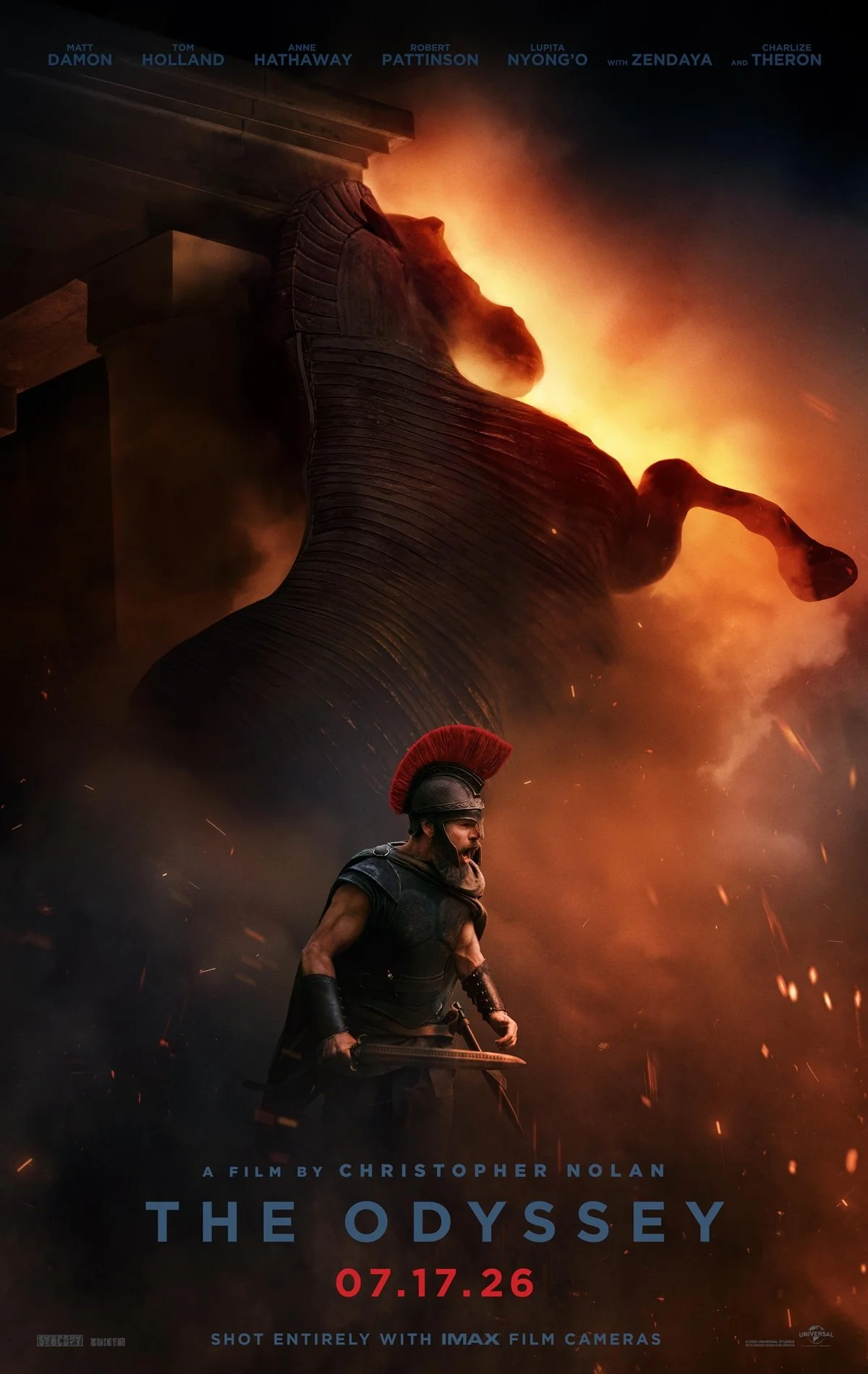
Christopher Nolan's adaptation of 'The Odyssey' (in theaters nationwide starting July 17) is a cinematic epic that will certainly appear on the list of 21st century film masterpieces.
In short: After the Trojan War, Odysseus (Matt Damon) faces a dangerous voyage back to Ithaca - while his wife Penelope (Anne Hathaway) and son Telemachus (Tom Holland) attempt to fend off suitors intent on claiming Odysseus's throne in his long absense. Robert Pattinson, Lupita Nyong'o, Samantha Morton, Zendaya and Charlize Theron also star.
It feels impossible to 'spoil' a story written nearly 3,000 years ago that is taught in virtually every school. And yet, what makes this film version incredible isn't merely some plot points or how closely this film adhears to Homer's epic poem - Nolan's adaptation is steeped in themes that ring as timely and relevant in the modernity of the 21st century without betraying the story's roots based in the Greek world of the 7th century BC.
Just to get it out of the way, even with its imposing nearly three-hour runtime, 'The Odyssey' isn't a purely faithful adaptation of the original work, which is a story told in 24 books. This film iteration tracks the story's most familiar storybeats, but remaining focused on two parallel plots: Odysseus trying to make his way home and Penelope resisting increasingly unruly suitors, with their time and patience running out.
As a general rule, three hours is an excessively long runtime for any movie - and honestly many movies approaching that three-hour mark simply do not justify such a bloated runtime. This is one of the exceedingly rare instances where the intimidatingly long runtime is one of the film's strengths: the film is supposed to feel like an arduously long journey. As Odysseus himself is beset with a years-long journey home, the audience must feel some version of that immense scale of time - and the three-hour runtime is a connective tissue between the protagonist's journey and the audience's experience.
In an era where anyone can stream practically any movie at anytime of the day to any device, 'The Odyssey' demands to be experienced in the movie theater. Most movies are merely consumable products - but 'The Odyssey' is an experience. It must be experienced on the largest screen possible. Those not fortunate enough to catch this film during its theatrical run - put this on the top of any must-see list as 'The Odyssey' will certainly return to theaters in the coming years and decades.
Christopher Nolan is the master of time. 'The Odyssey' is a story told across decades of time and told by characters at various points in time. For all the visual spectacle and wonderful acting performances in this film, the true standout star of 'The Odyssey' is editor Jennifer Lame. There's simply zero fat on this film - 'The Odyssey' is a lean, towering and enthralling achievement in storytelling. The audience is tossed around different points of time throughout the film - but its impeccable editing never feels jarring. The story never loses momentum - the characters, the story and the energy relentlessly keep moving forward.
Matt Damon and Anne Hathaway - as is the sprawling cast as a whole, making it the frontrunner for any Ensemble Cast award. The cinematography is arresting, especially in the framing of the film's key moments. And the film is packed while thrilling sequences featuring monsters of myth. But what makes this version of 'The Odyssey' in particular incredible ... is its focus on the follies of men. Writer-director Christopher Nolan's film is rooted in the agreed upon rules and customs that define civilized men. Breaking these laws of hospitality has mortal consequences at the micro scale - but this film quietly and subtly reveals the consequences of breaking these laws at the macro scale as well.
'The Odyssey' isn't merely some fun, swash buckling adventure across the seas. This story starts in the aftermath of a war, and reveals how the scourge of war spreads and inflicts punishment long after wars end, and the survivors are still left to survive in a world with eroding values. Thematically, ‘The Odyssey’ shares a lot in common with Nolan’s previous film ‘Oppenheimer’ in its ruminations on warfare and regrets.
Final verdict: 'The Odyssey' isn't merely an essential film of 2026 - it is likely the essential film of 2026.
Score: 5/5
'The Odyssey' opens in theaters nationwide July 17. This epic adventure has a runtime of 172 minutes and is rated R for violence and some language.